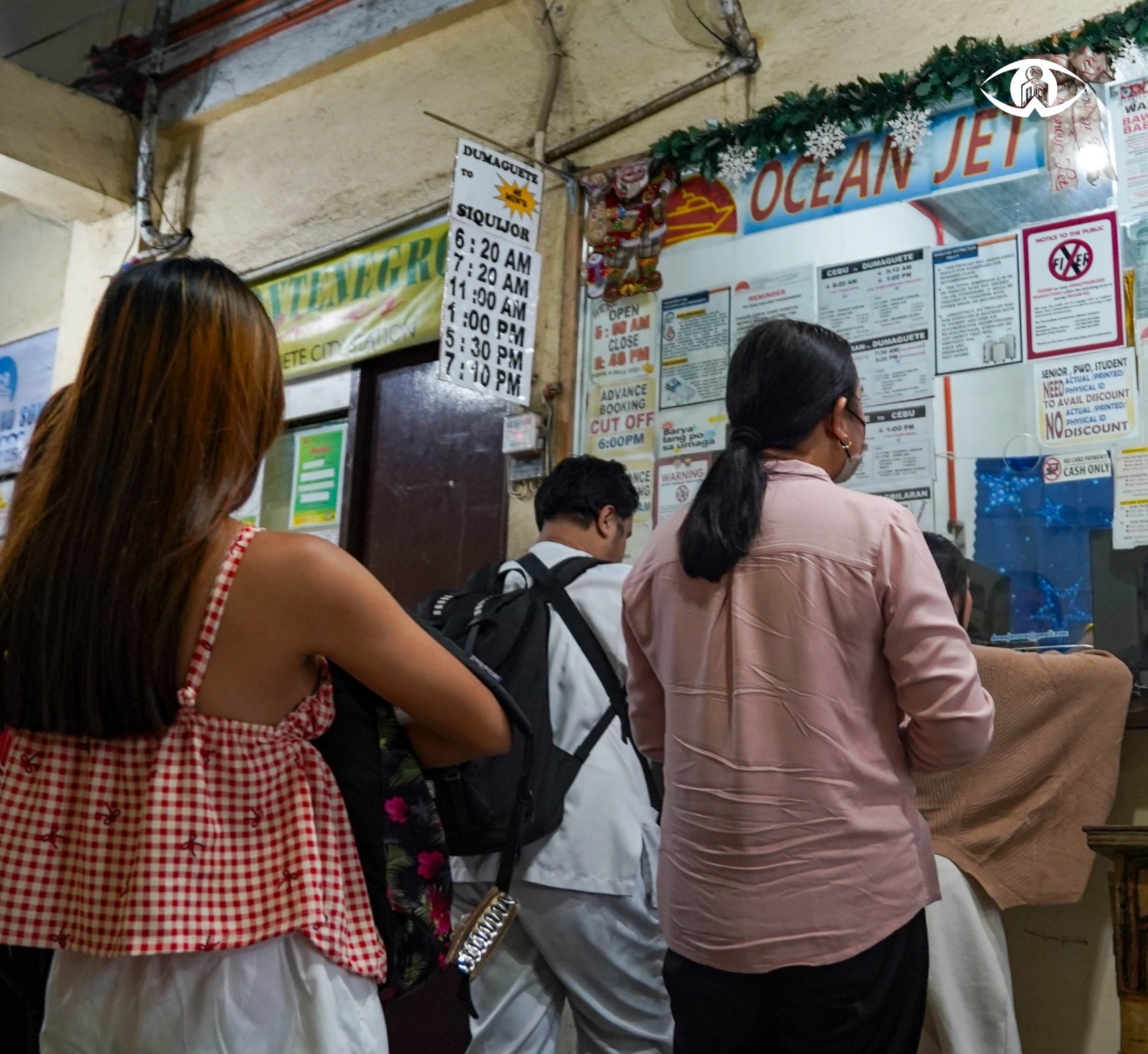

Students struggle in congested ports and delays amid holidays
By Deorafe Basong and Kaela Aidelynne Orcullo
Congested ports, long ticketing lines, and delayed trips have been a common part of the Filipino experience during the holiday rush. But for university students and commuters in Dumaguete, these challenges only highlight deeper systemic issues that compromise comfort, safety, and efficiency for those who rely heavily on sea travel.
The Port of Dumaguete, a critical gateway and window that connects Negros Oriental to its neighboring islands such as Cebu, Siquijor, Bohol, and Mindanao, struggles significantly during peak periods.
Ryan Duran, a security guard from Fastcat ferry company, shared his thoughts on the port’s current situation.
“Ang problema ania kay ang lugar. Kailangan ni padak-an. Sa holy week, napakaraming mga tao, dili masigo ug tarong, wala tay maagian,” he said.
(The problem here is the space. They should make it bigger [the pier]. During the holy week season, there are too many people, and the space cannot accommodate [them], there is no space to pass through.)
In 2021, the Department of Transportation and Philippine Ports Authority under the Duterte administration upgraded the port’s facilities through the construction of a two-story Port Operations Building (POB).
The project, described as a “state-of-the-art passenger terminal building,” aimed to properly monitor vessel arrivals and departures and provide efficient and reliable services to around 500 passengers.
However, another sentiment was echoed by Jaymar Ramirez, a ticket fixer, who remarked, “During the holidays, it’s so crowded here, the space is very little, and it is very scary that someone might faint again.”
The Philippines Port Authority (PPA) anticipated over two million passengers at ports nationwide during the Lenten Season, indicating the scale of traffic during such periods.
In 2025 alone, the passenger traffic in Dumaguete hit over 1,088,0000 million, one of the highest recorded by PPA in the Visayas region. Passengers also surged high in 2024 as it reached 1,700,000 million, compared to previous years.
For students who live far from Dumaguete, the persisting conditions at congested ports directly affect their academic and personal schedules.
Emmanuel Abuton, a third-year Political Science student at Silliman University, travels across islands to pursue his studies.
Coming from Oroquieta City, Misamis Occidental, Abuton relies on ferry transportation to commute between Mindanao and Negros, making him vulnerable to the travel disruptions, delays, and overcrowding during the holiday seasons.
“December is usually one of the most challenging times for me because of the mass amounts of travelers going back to their hometowns for the holidays,” Abuton said.
As a youth councilor in their barangay, Abuton also had to travel back-and-forth to attend to his responsibilities, which was affected by delayed trips.
“I missed some events related to my work, and it was an inconvenience for me because it is the only reason I went home for public engagements,” he shared.
Ticketing challenge
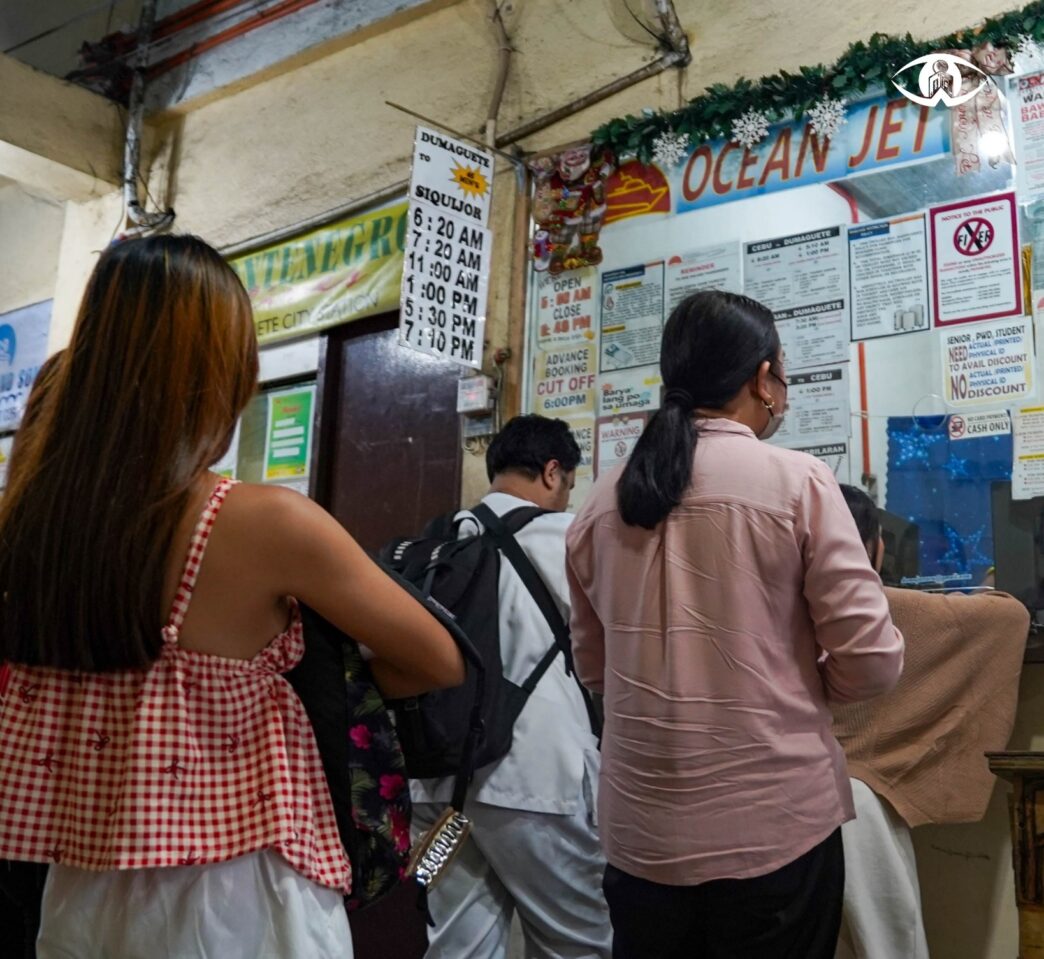
Another significant pain point for travelers during holidays is the lack of a streamlined ticketing process.
Blitz Seclon, a foreign affairs student, highlighted this, stating, “There is a lack of a systematic ticketing process, especially during holidays. I wish offices would have special systems for holidays to cater to a significantly higher number of customers”.
Duran also advised, “Ang mga customer, ang advice lang nako kay mag-online nga booking na lang sila, labi na ug ting-holidays. Wala ding first aid staff dito, hadlok gyud ug estudyante ka. Meron na pong nahimatay din dito.”
(People should do online bookings, especially if it is during [a] holiday. There is no first aid staff here, so it is dangerous, especially if you are a student. There are times in which people fainted.)
He suggested that students book tickets online or purchase them months in advance to avoid sellouts.
Moreover, Abuton recounted that the majority of the ferry trips that have online bookings are the ones that tend to sell out fast.
“For those who failed to book online, they would have to endure the long line of ticketing offices at the pier, and walk-in transactions usually take around one to three hours, depending on the season of travel,” he shared.
The Regional Development Council of Region 7 passed a resolution two years ago adopting the recommendation of the Negros Oriental Chamber of Commerce and Industry for shipping companies to adopt an online ticketing system.
While online booking offers a practical option for many travelers, not all shipping companies provide digital ticketing services, and some fail to offer discounts for students and seniors, even with early purchases.
Safety and tourism concerns
Beyond overcrowding challenges, the port’s infrastructure conditions pose additional safety concerns for travelers.
Duran observed, “Ang city unta, ila i-sigudado nga mawala na ang mga leaks dito. Kapag umuulan, ang tubig tumutulo galing sa kisame. Mas lisod na italay ug tarong.”
(The government [must] also make sure that there are no leaks here. When it rains, the water leaks through the ceiling, and it is harder for people to line up properly.)
This, despite the ticketing area being newly-renovated.
Furthermore, the presence of “ticket fixers” presents another problem, as noted by Duran.
“Mangayo na sila ug kwarta unya usahay pugos na,” he said.
(They ask for money, and at times they do it forcefully.)
Reports indicate that travelers are being forced to engage fixers to buy tickets from shipping lines, especially during peak travel seasons and fully booked trips.
“This practice has resulted in legitimate passengers being told that vessels are fully booked, only to discover later that seats remain available through these unauthorized channels,” Negros Oriental Governor Manuel Sagarbarria said.
The provincial and local government last May 2025 expressed its opposition to this anomalous system, urging the PPA and the Maritime Industry Authority (Marina) to act on complaints of “ticket fixers.”
According to Sagarbarria, the increasing number of reports from the traveling public damaged the province’s tourism reputation as travelers tend to avoid Dumaguete as a gateway and prefer to use alternative ports.
In response, authorities pledged to investigate and act on the matter and seek proper measures to curb fixers in the port area.
In a university town like Dumaguete, thousands of students regularly travel in and out of the city during holidays and summer breaks.
Yet, what should be a long-anticipated vacation is marred by challenges as students still had to compete with many travelers and an overcrowded port.
“I think that the government can help by improving facilities in ports, such as providing better accommodations in waiting lounges,” Abuton stressed.
He added, “For the school, I think that they do not have control on the trips themselves, but they could, however, provide ways to ease the pressure of students going back to their hometowns during holidays by giving adequate time for them to prepare and not rush.”
He also proposed that universities can impose an earlier date of examinations to help students plan and prepare ahead of their travel.
As congested ports, long ticketing lines, and delayed trips continue to define the holiday rush for student-commuters in Dumaguete, these systemic failures not only disrupt academic schedules and personal lives but also expose vulnerabilities in safety and efficiency, which every student deserves.
If the government prioritizes port expansions, streamlined online ticketing, and anti-fixer measures to safeguard student travelers, it will open sea gateways to support education and mobility.